

Home / News & Applications /Applications
The inverter is the core component of any photo-voltaic (PV) system, directly impacting power stability and long-term operation and maintenance costs. On-grid inverters and hybrid inverters are the two mainstream options on the market—and the two most easily confused by buyers. However, their operating logic and total cost of ownership differ significantly. Making the wrong choice can lead to unexpected power outages, budget overruns, and complicated maintenance. So, how do you choose the right inverter for your situation?
First, understand the core differences between on-grid and hybrid inverters.
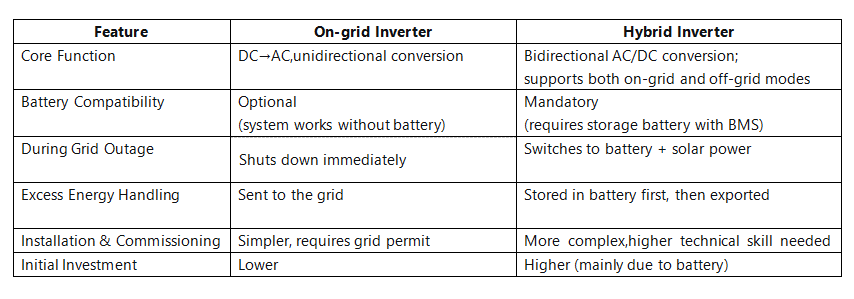
Next, match the inverter type to your application scenario.
Choose an on-grid inverter if:
1.Your grid is reliable (less than 3 outages per year).
2.Your main goal is to save on bills or sell excess power.
3.You don't have critical equipment that needs 24/7 power.
Choose a hybrid inverter if:
1.You live in an area with frequent outages or unstable grid.
2.You have high-reliability requirements—such as hospitals, aquaculture farms, or factories that demand 24/7 operation of essential equipment.
3.You want to store solar power during the day and use it during peak-rate evening hours to benefit from large time-of-use price gaps.
In summary:
There is no universally "better" option, only the one that best matches your specific power environment. If your grid is reliable, your budget is limited, and backup power is not a priority, the on-grid inverter offers excellent cost‑effectiveness. If you face frequent outages, must protect critical loads, or wish to take active control over your energy costs, the hybrid inverter provides a more robust and flexible solution.
Back to the Top

5th Floor, Building B, No.2817 Kaichuang Avenue, Science Zone, Huangpu District, Guangzhou, China
+8620-89269660 | 89269662 | 89269669


